


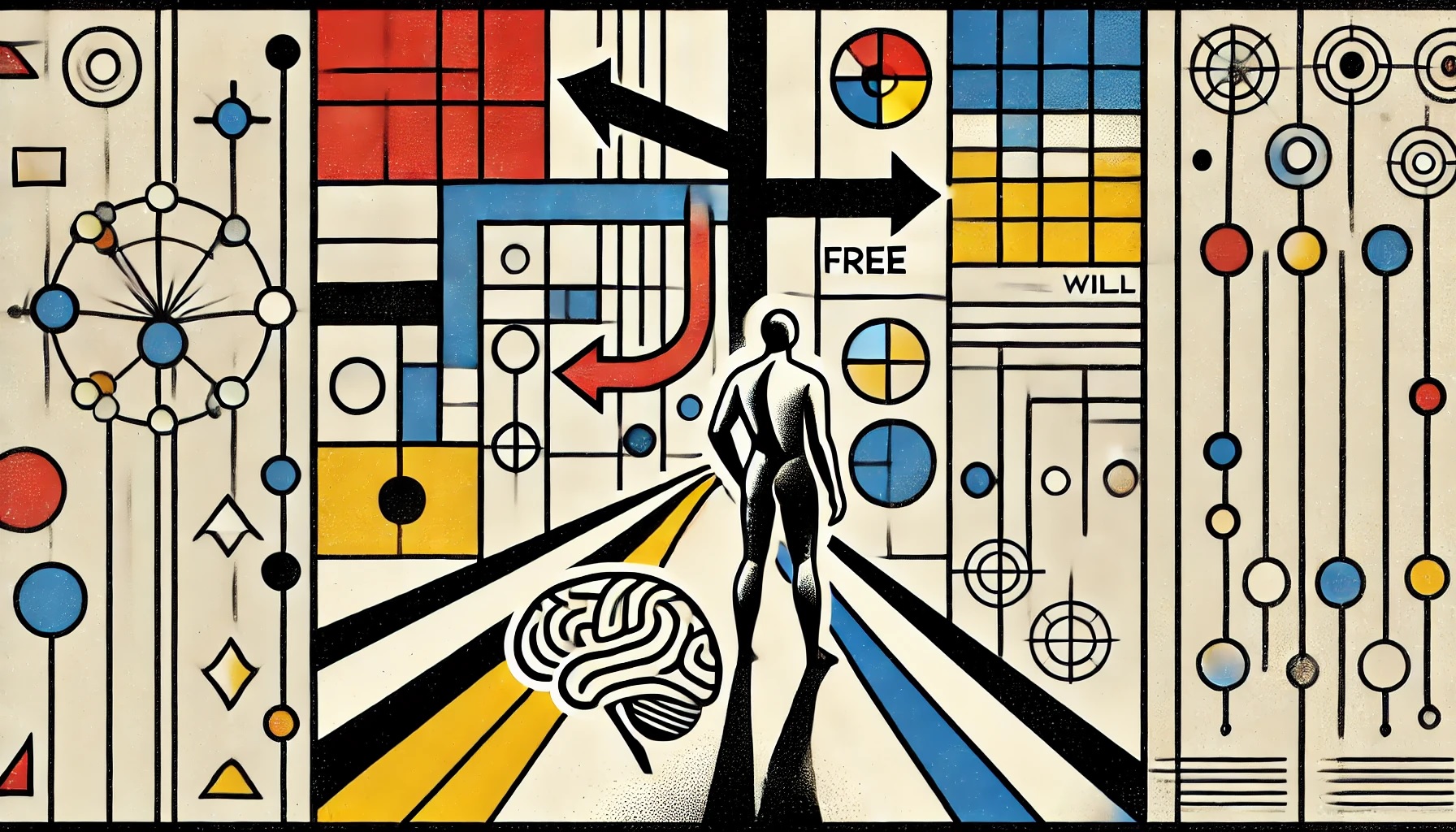

Free will. What does it mean? Do human beings make free choices or are all our actions predetermined by the combined effect of our upbringing and genetics? This topic is not only central to philosophical research, it is also central to those who are involved in artificial intelligence.
The 25th World Congress of Philosophy, which took place last week in Rome, featured prominent names such as Ye Zeng, an expert in artificial intelligence ethics, and David Chalmers, a philosopher of the mind who advocates a dualistic but non-Cartesian conception of consciousness. And that is no coincidence.
Free will is not just one of the questions we encounter with AI. It is THE question at the heart of the titanic challenge of creating intelligent objects. In their effort to create “autonomous machines”, researchers are forced to ask: “autonomous from what?” And so, in a constant game of subtraction, they try to to peel away the layers of the onion one by one — the programmer must disappear as much as possible. The machine must learn from examples. But who should determine the configuration, the architecture, the size of neural networks that are capable of learning? Engineers? Of course not! So they look for a selective evolutionary mechanism that makes these systems converge towards the most effective solution. But how much does this selective mechanism, built with genetic networks, resemble Darwin’s evolution? Too little! Which brings the question of how to define a function that oversees selection without engineers being involved. But then do we want to try and have a system designed by a generative model? And how autonomous is a generative model? Not that much! Because it reproduces the texts it was trained on. It doesn’t invent anything!
At each step, the question remains the same: how to reconstruct thoughts with machines? Real thoughts, not ones created externally. And this forces us to ask ourselves: what is different about our thoughts? Where does our mind reside? Is consciousness an “emergent feature” of a complex neural system, as most AI researchers imagine, or is it a phenomenon separate from the direct materiality of our brain, as Descartes said (and as Chalmers retiterated with some modifications)? Because in the first case, our actions can only be determined by our physical nature, whereas in the second case, we bend matter to our will, our free will. But there is also a third way, as suggested by the physicist Roger Penrose, for instance. The mind is indeed material but it is also linked to phenomena such as quantum physics, which implies indeterminacy, and thus leaves enough room for freedom. Physicists generally seem to like this idea, it means we can have our cake and eat it. It is certainly a fascinating hypothesis.

But ultimately, where does intelligence start? With life? And when does life begin? There is still no universally accepted definition of life. Is it with life that the first spark of autonomous will is ignited? That is the underlying question at the heart of the annual conference of the Artificial Life Society. I had the privilege of participating in this year’s edition, which took place from 22 to 26 July in Copenhagen. It was an amazing event.
It is impossible to mention all the interesting things I saw, but here is a partial list, in no particular order: the work of Takahide Yoshida’s research group which integrated a humanoid robot with GPT-4, the synthetic choir of robots from the Universities of Namur and Brussels, the research of Bert Chan from Google Deepmind and Martin Biehl from Cross Compass on the origin of will (Google Research and Springer), the Simsulator software of Michael Finn from the University of Western Australia (MIT) simulating the evolution of virtual creatures.
Then, there is the fascinating work of Seth Bullock on the relationship between individual and collective intelligence and his research with Conor Houghton on the origin of language, the neuroevolutionary models of Sebastian Risi and his team, Tim Taylor’s dive into the history of the concept of autonomous machines, and Dylan Cope’s study of mimicry as a possible behavioural spark for language.
We live in a wonderful period in which philosophy and science are finding a new harmony. But we are distracted by so many conflicts at every level. Yet we have never had as many tools to understand something about human nature. Let’s hope that amid so many conflicts, identity wars, and imminent dystopias, these answers will still be of interest to us.
